Where the 7:1 Rule Came From
The "one human year equals seven dog years" rule has no real biological derivation. The most plausible historical reading is that it is a rough rule-of-thumb encoded in nineteenth- and twentieth-century veterinary advice, derived from the loose observation that humans typically lived around 70 years and dogs around 10. The arithmetic is what produced the 7:1 number; the biology was never load-bearing. The rule survived because it is easy to remember and easy to apply, not because it tracks the underlying aging trajectory.
Both pieces of the modern picture — the non-linearity of aging within a dog's life, and the body-size modulation across breeds — break the rule cleanly.
The Non-Linearity: What the Methylation Clock Shows
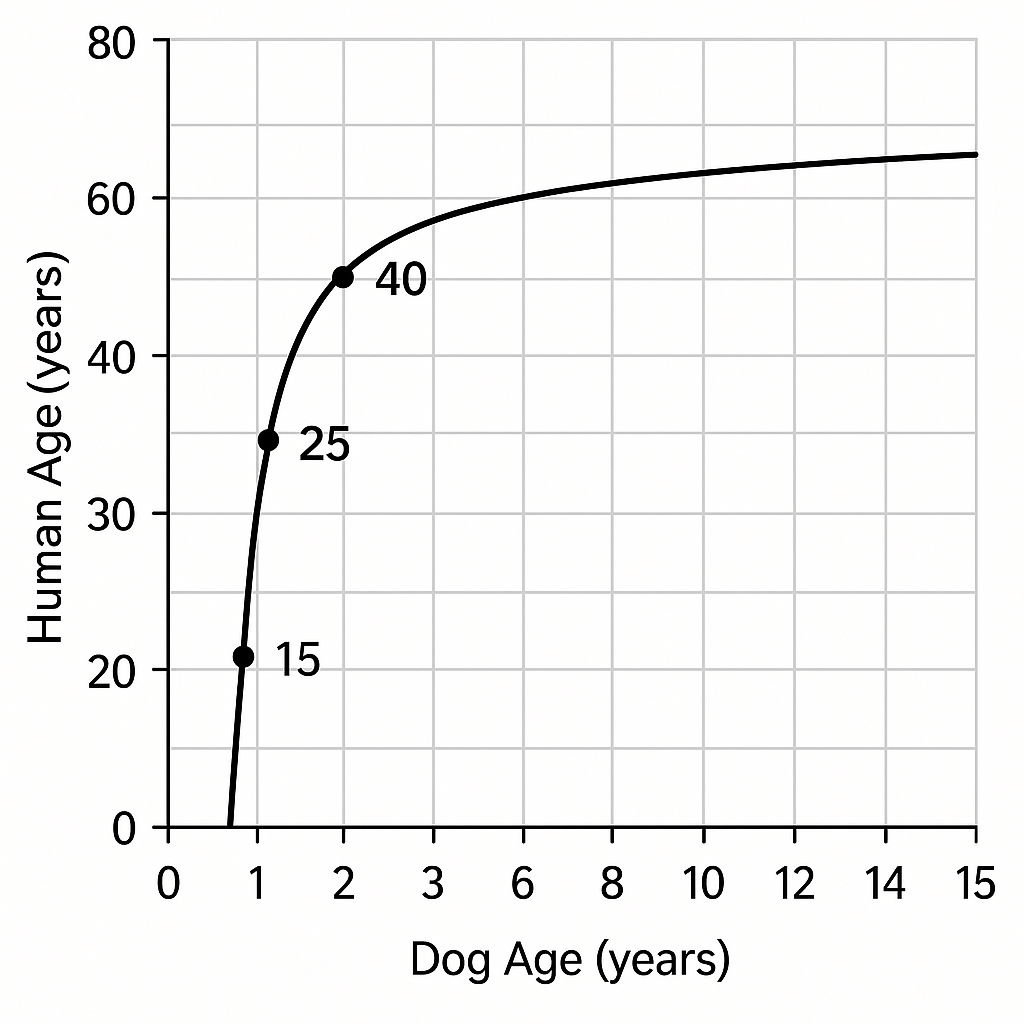
DNA-methylation patterns change with age in a fairly conserved way across mammals, and the rate of change at specific genomic positions is now used as a molecular "clock" of biological age. Wang and colleagues (2020) constructed a methylation-based translation between dog and human age using a sample of Labrador Retrievers and a comparison human cohort[^wang2020]. The result is the curve that has become the standard reference: dog age maps to human age through a logarithmic function rather than a multiplicative one. In words rather than equations:
- A dog at 1 year of life is, in molecular-aging terms, comparable to a human in the early-mid teens. The early life of a dog is enormously compressed; the puppy phase is roughly equivalent to about fifteen human years of development.
- A dog at 2 years has moved a smaller increment in human-years terms — to roughly the mid-twenties.
- After the early-life compression flattens out, additional dog-years correspond to increasingly small human-year increments, with later life-stage transitions still recognisable but the per-year multiplier well below seven.
The exact numerical translation is breed-size-dependent and the Wang paper is explicit that the curve was fit on Labradors; smaller and larger breeds have somewhat different curves. The qualitative shape — fast in the first year or two, much slower after — is what is robust.
The Body-Size Modulation
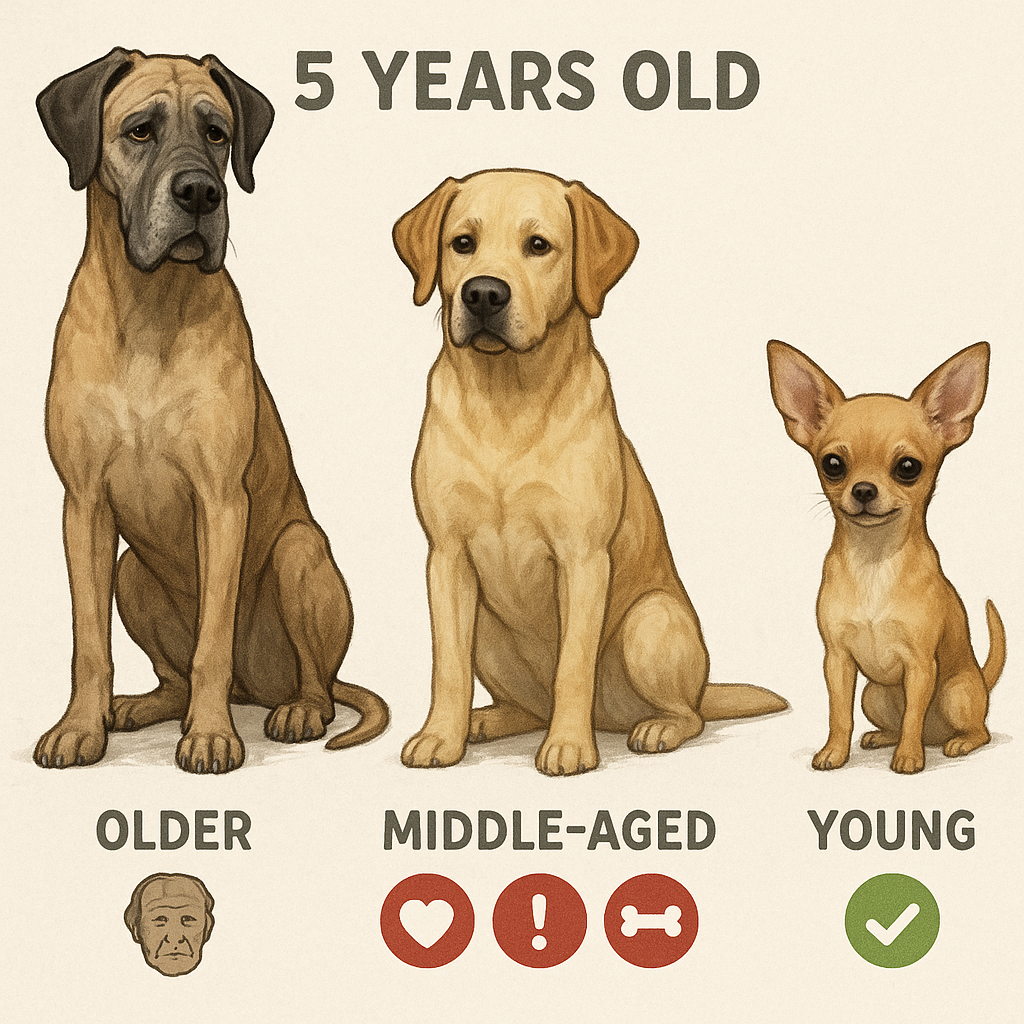
The other major break in the 7:1 rule is between breeds rather than within a single breed's lifespan.
Across mammals as a class, larger species typically live longer than smaller ones. Within the domestic dog, the relationship reverses: larger breeds live shorter lives than smaller ones, sometimes by a factor of two. Great Danes and Irish Wolfhounds typically live 7-9 years; Chihuahuas and small terriers commonly reach 14-16. The same population of Canis familiaris shows one of the steepest within-species body-size-and-longevity gradients known.
Greer and colleagues (2007) characterised the relationship at population scale, finding that height and weight both negatively predict lifespan in a large dog sample[^greer2007]. Kraus, Pavard, and Promislow (2013) decomposed this further: large dogs age faster, in the sense that they reach age-equivalent disease and physiological-decline endpoints sooner; the size-lifespan trade-off is not just about higher mortality risk in any given year but about the rate at which the underlying aging process progresses[^kraus2013]. The biology behind the gradient — IGF-1 signalling, growth-related cellular trade-offs — is an active research area; the epidemiology is well-attested.
The combined picture is that any "dog years" rule that ignores body size averages over a real and large source of variation. A 5-year-old Great Dane is biologically much older than a 5-year-old Chihuahua; describing both as "35 in human years" is wrong about both, in opposite directions.
What to Use Instead
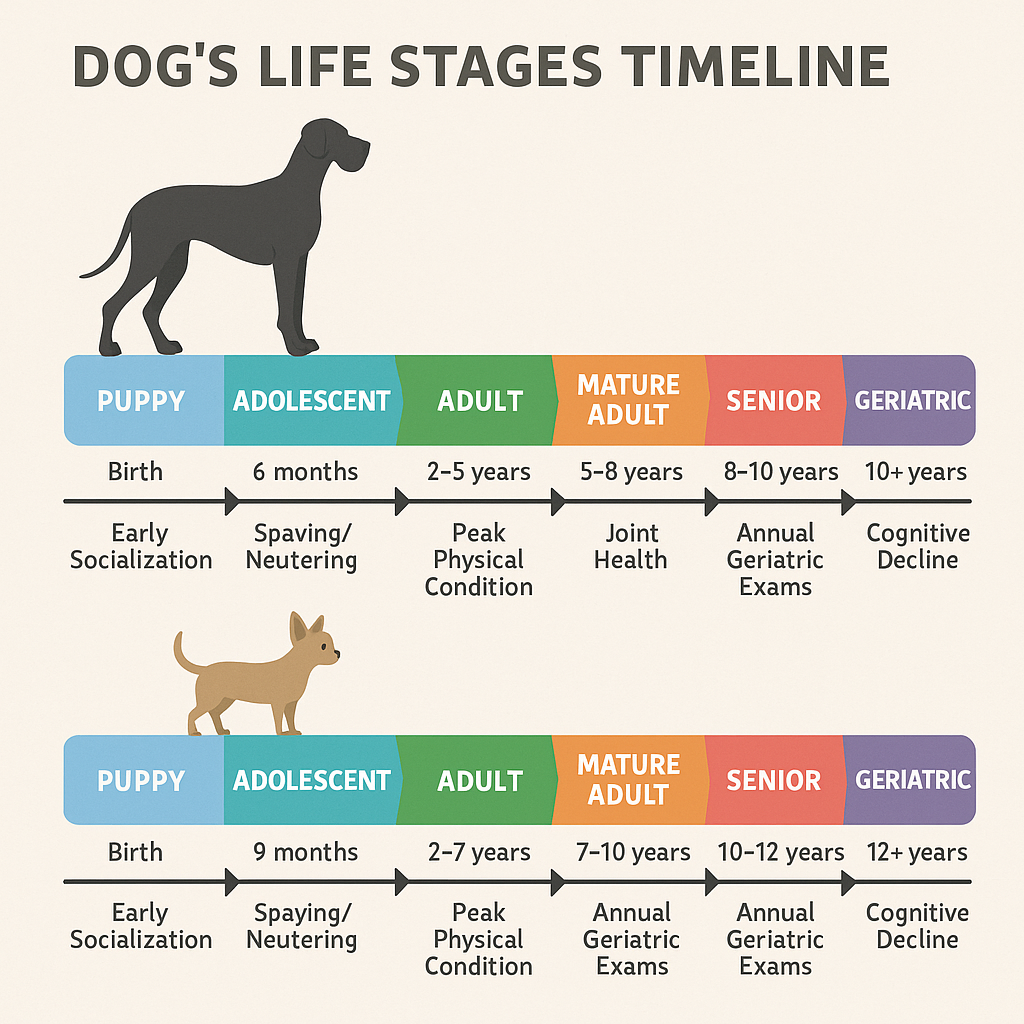
Two practical replacements, both more useful than a multiplier.
Use breed-size life stages, not multipliers. Veterinary life-stage frameworks bin dogs into puppy, adolescent, adult, mature adult, senior, and geriatric stages, with the boundaries shifted earlier for larger breeds. A Great Dane is a senior at six; a Chihuahua is not until ten or eleven. Senior wellness screening, dental and joint monitoring, and dietary adjustments should be timed against the life-stage milestone, not against a calendar year.
For a quick estimate, use the Wang-style logarithmic translation rather than a multiplier. A reasonable mental approximation: the first year is worth about fifteen human years; the second is worth about another nine; resulting years are worth roughly four to five each, with the multiplier shrinking somewhat as the dog ages further. This is closer to the molecular picture and closer to what the lifespan data show, especially for large breeds where the early-life compression is even sharper.
What Is and Is Not Settled
Settled: aging in dogs is non-linear; body size strongly modulates lifespan and the rate of biological aging; the 7:1 rule is not supported by either the molecular or the epidemiological data.
Not settled: the precise functional form of the dog-to-human translation across all breed sizes, and the mechanistic biology of the body-size-and-longevity gradient. The methylation clocks are good but not yet calibrated across the full breed range, and the IGF-1 / cellular-aging story is incomplete.
Key Takeaways
- The 7:1 "dog years" rule is a folk rule of thumb without molecular or epidemiological support.
- The methylation-clock work (Wang 2020) shows aging maps logarithmically: about 15 human-years for the first dog-year, smaller increments thereafter.
- Body size strongly modulates lifespan and aging rate (Greer 2007; Kraus 2013) — large dogs age faster and die younger than small ones.
- Use breed-size life-stage frameworks rather than a multiplier when timing senior wellness, diet, and exercise adjustments.
- The qualitative direction of these findings is robust; the precise per-breed numerical translations are still an active research area.
Sources & further reading
- Wang, T.; Ma, J.; Hogan, A. N.; Fong, S.; Licon, K.; Tsui, B.; Kreisberg, J. F.; Adams, P. D.; Carvunis, A.-R.; Bannasch, D. L.; Ostrander, E. A.; Ideker, T.. (2020). Quantitative translation of dog-to-human aging by conserved remodeling of the DNA methylome. Cell Systems, 11(2), 176-185.e6. https://doi.org/10.1016/j.cels.2020.06.006
- Greer, K. A.; Canterberry, S. C.; Murphy, K. E.. (2007). Statistical analysis regarding the effects of height and weight on life span of the domestic dog. Research in Veterinary Science, 82(2), 208-214. https://doi.org/10.1016/j.rvsc.2006.06.005
- Kraus, C.; Pavard, S.; Promislow, D. E. L.. (2013). The size-life span trade-off decomposed: why large dogs die young. American Naturalist, 181(4), 492-505. https://doi.org/10.1086/669665