The "Big Dog, Big Yard" Misframing
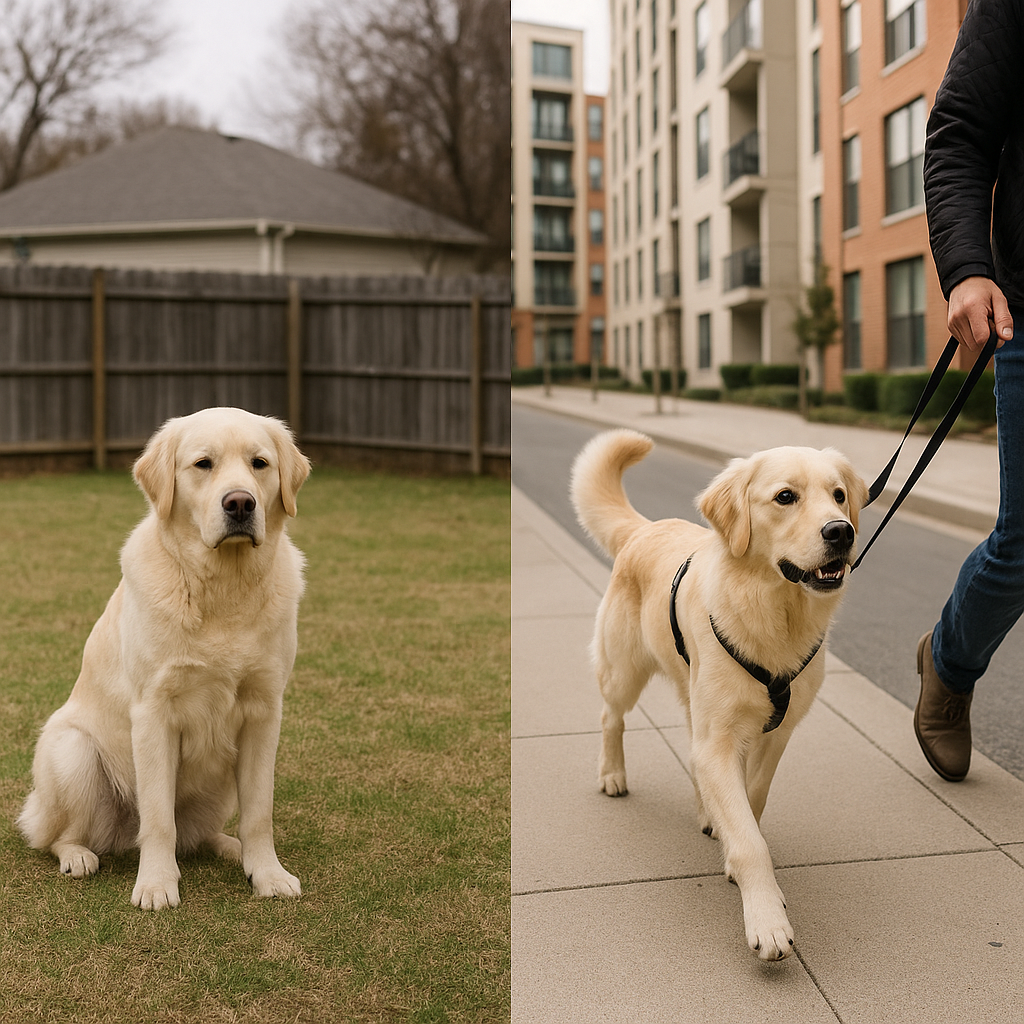
The popular intuition is that large dogs need large yards. The intuition is partly right and partly wrong. What dogs need is appropriate exercise, mental stimulation, social interaction, and management; a yard provides one form of space but does not automatically provide the full picture.
Some apartment-living dogs have substantially better quality of life than some yard-living dogs:
- Apartment-living dogs are typically taken on multiple structured walks daily. The walks provide exercise, mental engagement (sniffing, environmental exposure), and direct human interaction. Yard-dwelling dogs whose owners use the yard as a substitute for walks may be sitting in the yard with little engagement.
- Apartment-living dogs are typically more integrated into household life. They are inside with the family rather than in a separate yard space. Social engagement is higher.
- Apartment-living dogs often have more varied environmental exposure. Different neighborhoods on different walks, varied environments, more diverse stimuli than the same yard daily.
- Apartment-living owners are typically more engaged with management. The constraints of apartment life require deliberate attention to exercise, training, and behaviour management; yard-living owners sometimes default to low-engagement.
This is not to say all apartment dogs are well-served and all yard dogs are not. The point is that what matters is the management, not the square footage. Large dogs can absolutely thrive in apartments with appropriate management; large dogs can absolutely fail in yards with inappropriate management.
What Apartment-Living Large Dogs Actually Need
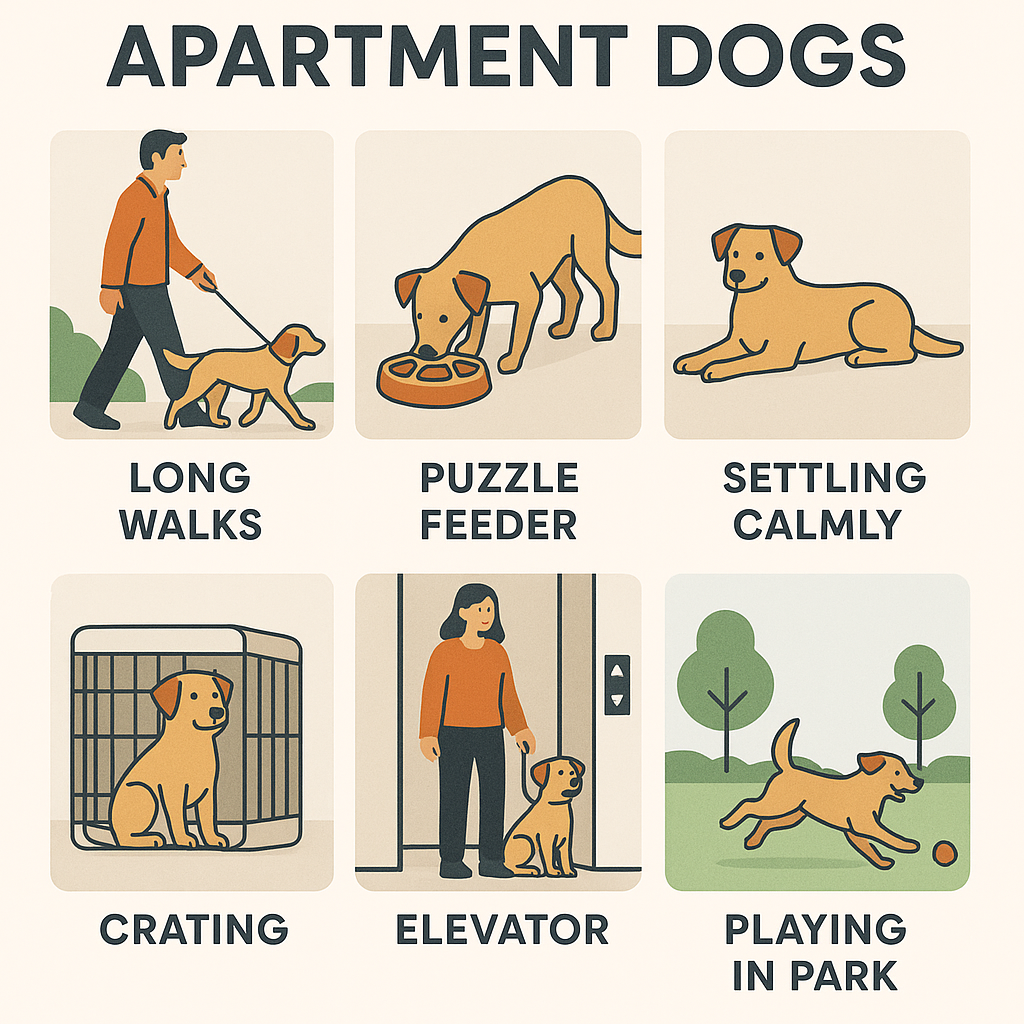
A practical breakdown:
Substantial daily exercise. Most large breeds need 60-120+ minutes of structured exercise daily, sometimes more for high-drive breeds. The exercise should include:
- Long walks (45-90 minutes) at appropriate pace.
- Off-leash time in dog parks, hiking trails, or fenced spaces (if appropriate for the dog's social skills).
- Specific high-engagement activities multiple times per week (fetch, swimming, sport activities, structured play).
- Avoiding excessive high-impact exercise in young growing dogs (covered in growing-pains article).
Mental enrichment. Cognitive engagement reduces apartment-related boredom and supports settling. Puzzle feeders, scent work, training sessions, novel-object exploration, and varied walks all contribute. The cognitive-enrichment-life-stages article covers the broader framework.
Settle behaviours. A dog who can settle calmly in the apartment for stretches of the day is better-suited to apartment life than a dog who cannot settle. Settle training (covered in the release-cues article and duration-building article) supports apartment compatibility.
Noise management. Apartments have neighbors; barking is a frequent source of complaints. Excessive barking has multiple causes (anxiety, alarm, boredom, frustration); identifying the cause supports the right management approach. The delivery-driver-management article covers doorbell-and-delivery triggers specifically.
Crate and confinement training. A dog who is comfortable in a crate or confined area handles apartment life better than one who is not. Crate training supports both safety (during owner absence) and management of small spaces.
Elevator, stair, and corridor competence. Large dogs in apartments typically navigate elevators, stairwells, and shared corridors. Calm appropriate behaviour in these contexts is part of apartment-living management.
Outdoor accessibility. Practical access to walking routes, parks, and green spaces matters. Buildings without easy outdoor access produce specific challenges.
Practical Protocols
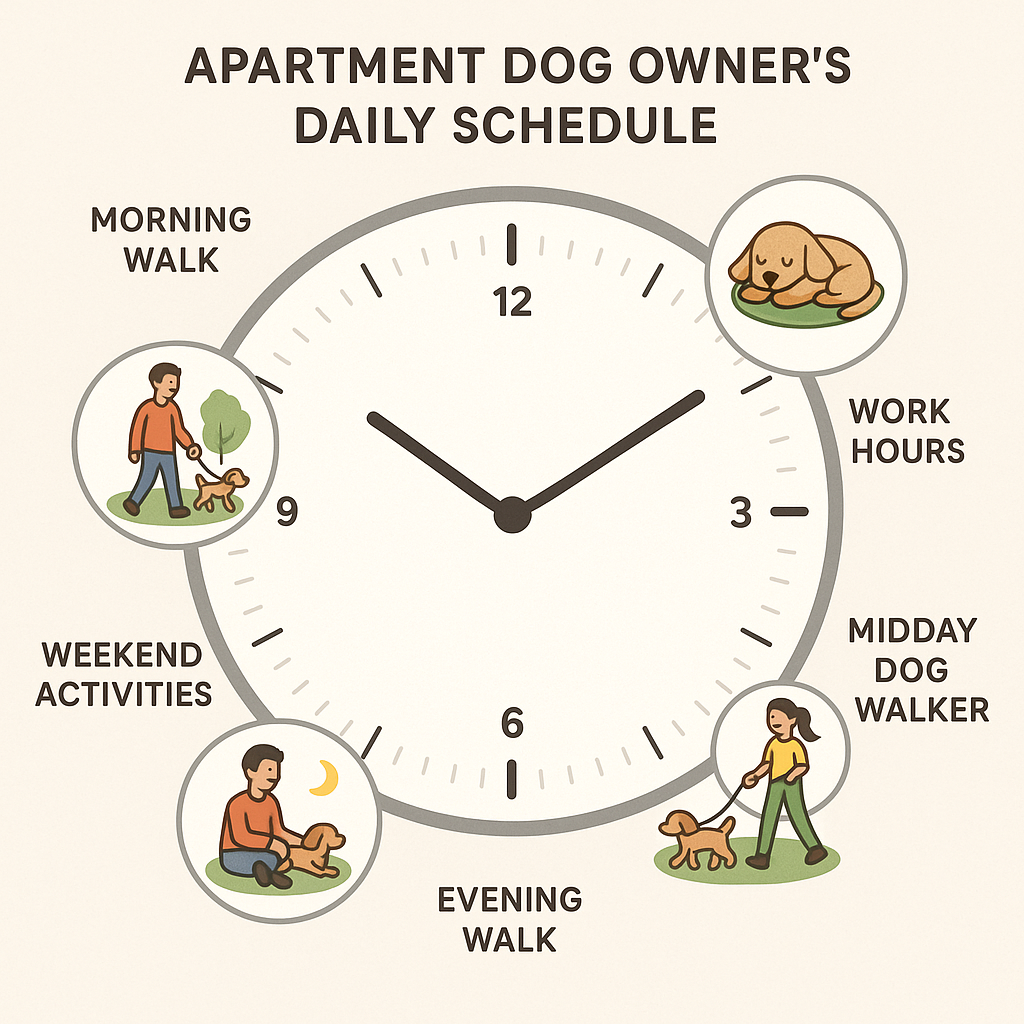
A workable framework for the apartment-living owner:
Morning routine. A substantial walk before the owner's day starts; settles the dog into a calm state for the daytime alone hours.
Midday option. Some owners use dog walkers, lunch-time visits, daycare, or other arrangements during long workdays. Dogs left alone for 8-10+ hours daily without midday options often show the strongest stress signs.
Evening engagement. Another substantial walk or active engagement; the most predictable time for dog-owner interaction in apartment routines.
Weekend and longer-engagement opportunities. Hikes, off-leash play, sport activities, longer walks, varied environments — provide the mental and physical demands that the daily routine cannot fully meet.
Daily mental enrichment. Puzzle feeders, training sessions, scent games — the variety of activities can be substantial without requiring outdoor space.
Noise-management protocols. Visual barriers (curtains, window film) reduce trigger exposure; white noise can mask environmental sounds; specific behavioural management for neighbour-related triggers.
Building-rules navigation. Some buildings have weight limits, breed restrictions, dog-specific rules. Honest engagement with the rules and the building management produces better long-term outcomes than working around them.
Specific Breed Considerations
Some large breeds adapt to apartment life more readily than others:
Generally apartment-friendly large breeds (with appropriate management):
- Greyhounds (low-energy at home, despite the racing heritage; "couch potatoes" with daily walks).
- Mastiffs and Mastiff-type breeds (low-energy adults).
- Great Danes (low-energy as adults despite size).
- Some retrievers (Labradors and Goldens with appropriate exercise).
More challenging in apartments:
- High-drive working breeds (Border Collies, Belgian Malinois, German Shepherds in working lines) — need substantial cognitive and physical engagement.
- High-vocal breeds (some hounds, some terriers) — noise-management can be challenging.
- High-territorial-bark breeds — may produce neighbor complaints from alarm-barking.
Individual variation matters considerably. A specific Border Collie with appropriate engagement may do better in an apartment than a specific Great Dane without it. The breed framework is a starting hypothesis.
Common Problems and Solutions
Bark complaints from neighbors.
- Identify the trigger (visitors, hallway sounds, neighbouring dogs, environment).
- Behaviour-modification for the specific trigger pattern.
- Environmental management (visual barriers, white noise).
- Consider veterinary-behaviourist consultation for severe cases.
Insufficient exercise leading to indoor problems.
- Increase daily walk duration and structured activity.
- Add midday options for long-workday households.
- Increase mental enrichment.
- Consider dog-sport participation for high-drive dogs (see dog-sports-matching article).
Elevator or corridor anxiety.
- Desensitisation work using counter-conditioning.
- Off-peak routing if elevator anxiety is the issue.
- Stairwell training as an alternative.
Building-restriction issues.
- Honest engagement with building management about specific concerns.
- ESA documentation if genuinely applicable (see esa-system-abuse article for legitimate documentation).
- Service-animal status if applicable (see therapy-dogs-vs-esa article).
- Accepting that some buildings simply will not accommodate; finding pet-friendly alternatives.
Aging dogs and apartment elevators. Senior dogs with mobility issues may need elevator access; ground-floor or elevator-accessible apartments matter for senior care.
What This Does Not Imply
- Apartments are universally suitable for large dogs. Some specific dogs (particularly high-drive working breeds without sufficient outlet, or dogs with severe noise-reactivity) struggle.
- Yards are universally inferior. They are not. The point is that yard alone is not the welfare metric; management is.
- Apartment management is straightforward. It requires substantial owner engagement; the article emphasises that engagement, not minimal effort.
What Is and Is Not Settled
Settled: dog welfare in apartment vs. yard contexts depends primarily on exercise, mental stimulation, social interaction, and management rather than on square footage; large breeds can thrive in apartments with appropriate management; specific apartment-living considerations (noise, building rules, elevator/corridor management) require attention[^avma][^apdt].
Not settled: precise quantitative comparisons of welfare outcomes in apartment vs. yard contexts; optimal protocols for the spectrum of large breeds in apartment settings.
Key Takeaways
- Large dogs can thrive in apartments with appropriate management; "big dog, big yard" is partly a misframing.
- What dogs need is appropriate exercise, mental stimulation, social interaction, and management — all providable in apartment contexts.
- Apartment-living large dogs often have better-managed exercise, higher household integration, and more varied environmental exposure than some yard-living dogs.
- Practical protocols: substantial daily exercise (60-120+ minutes), mental enrichment, settle training, noise management, crate/confinement training, building-rules navigation.
- Some breeds adapt more readily (Greyhounds, Mastiffs, Great Danes, Labradors); others (high-drive working, high-vocal) are more challenging.
- Common problems (bark complaints, exercise deficits, elevator anxiety, building restrictions) have practical management solutions.
Sources & further reading
- American Veterinary Medical Association. AVMA Urban Dog Ownership Resources. American Veterinary Medical Association. https://www.avma.org/
- Association of Professional Dog Trainers. APDT Apartment Living Guidelines. Association of Professional Dog Trainers. https://www.apdt.com/